guide
Scale of the universe: from Earth to other galaxies
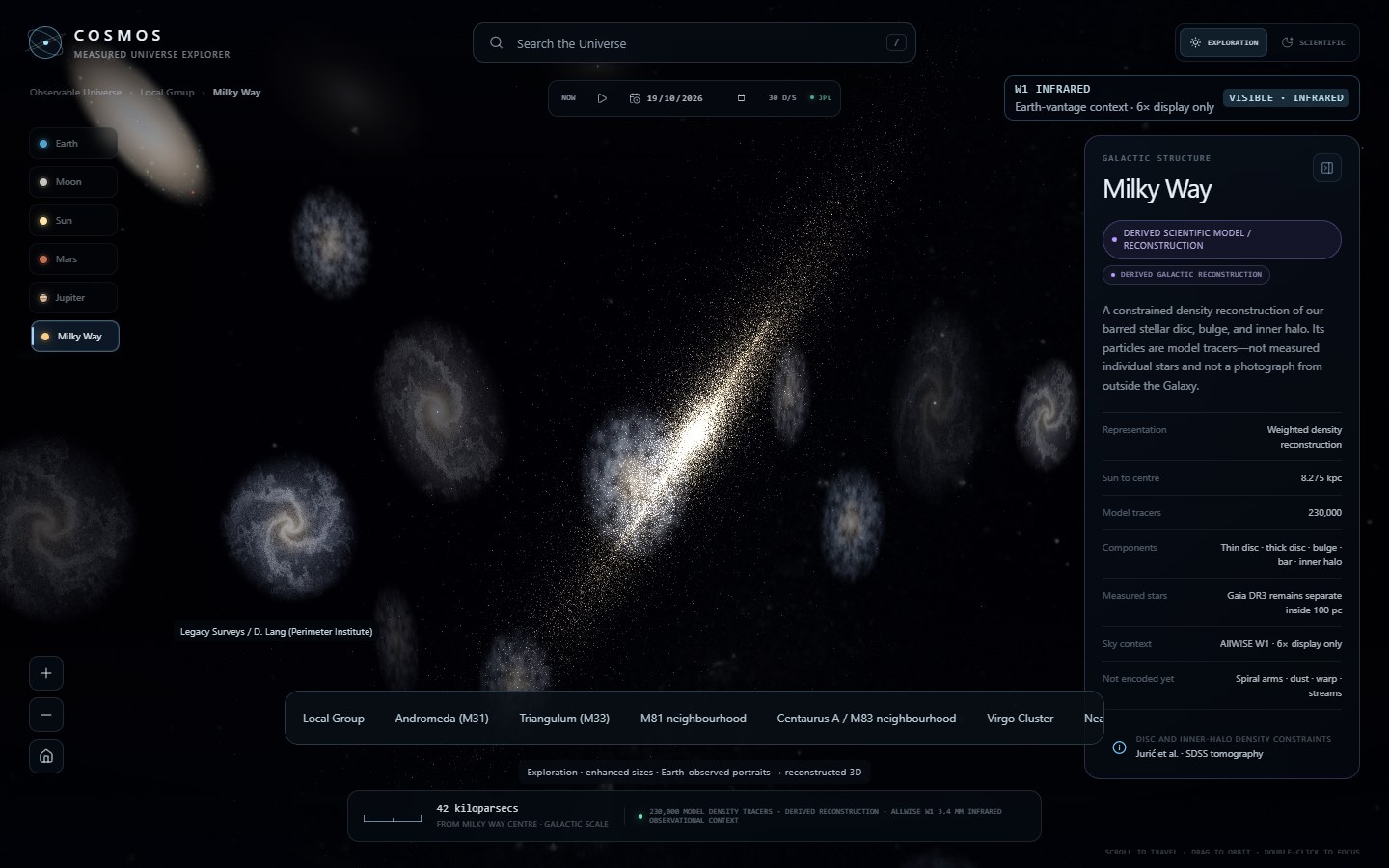
Earth is one planet in the Solar System. The Sun is one star in the Milky Way, and our galaxy is one member of the Local Group alongside Andromeda and Triangulum. Explore those changes of scale in COSMOS, then compare the actual distances, units and data limits below.
Measured facts
- Earth mean radius
- 6,371.0 km
- Moon mean radius
- 1,737.4 km
- Sun mean radius
- 695,700 km
- Jupiter mean radius
- 69,911 km
- Earth–Moon distance
- 387,439 km at the recorded epoch
- Measured stellar volume
- 100 pc around the Sun
- Sun’s Galactocentric radius
- 8.275 kpc, as used by the COSMOS Milky Way model
From a planet to an orbit
The ladder starts with bodies. Earth's published mean radius is 6,371.0 km, and the Moon's is 1,737.4 km — large enough, relative to its planet, that the Earth–Moon pair is sometimes described as a double system.
The first real jump is the Moon's orbit: 387,439 km, which is roughly thirty Earth diameters and about 1.3 seconds of light travel.
From an orbit to a light year
Planetary separations are naturally measured in astronomical units. Mars sits 1.866 AU from Earth at the recorded snapshot epoch, and that number changes constantly as both planets move; the guide on Earth–Mars distance covers the measured extremes and their dates.
Beyond the Solar System the unit changes again. The nearest named star in COSMOS is Proxima Centauri at 1.302 pc, derived from a measured Gaia parallax rather than a quoted textbook value.
From light years to kiloparsecs
COSMOS's measured stellar volume reaches 100 pc, containing 371,766 individual Gaia DR3 sources. That is a bubble around the Sun, not a map of the Galaxy.
The galactic step is a different kind of quantity: the Sun sits 8.275 kpc from the Galactic centre in the model parameters COSMOS uses, and the reconstruction samples structure out to a declared 20 kpc boundary. Beyond that boundary COSMOS does not extrapolate.
From the Milky Way to the Local Group and beyond
The 20 kpc boundary belongs to the Milky Way reconstruction, not to the whole explorer. Continue outward to the Local Group, Andromeda, Triangulum, nearby galaxy groups and wider catalogue structures. These are separate data layers with their own distance uncertainties and selection limits; they are not an extrapolation of the Milky Way density model.
A parsec is about 3.26 light-years; a kiloparsec is one thousand parsecs and a megaparsec is one million. The nearby Gaia volume, the Galaxy and the separations between galaxies therefore need different rulers. The on-screen scale describes the camera distance from the named reference centre, not the diameter of every object on screen.
Exploration mode enhances the apparent sizes and brightness of distant galaxies so that you can discover them. Scientific mode prioritizes physical sizes. Both retain the same catalogue coordinates. An observed galaxy portrait and a navigable reconstruction of its unseen depth are different representations, not interchangeable measurements.
Content updated 2026-10-25. Every value on this page is computed from the shipped datasets; where a source publishes no value, the page says so instead of estimating one.