guide
How far away is Andromeda?
The COSMOS catalogue places Andromeda (M31) 783 kiloparsecs away, with a published uncertainty of ±25 kpc. That is about 2.55 million light-years: the light reaching us began its journey long before human civilisation.
Measured facts
- Catalogue distance
- 783 ± 25 kpc
- Light-travel scale
- About 2.55 million yearsDistance divided by light speed; not a prediction of a spacecraft journey.
- Source release
- McConnachie 2012; not a claim of the latest distance determination
- Neighbours
- Milky Way and Triangulum (M33), within the Local Group
Why do sources say 2.5 million light-years?
A light-year measures distance, not age. One kiloparsec is approximately 3,261.56 light-years. Multiplying the catalogue value by that conversion gives about 2.55 million light-years; rounding explains the familiar 2.5 million figure used by NASA. A quoted distance is an estimate with a method and uncertainty, not a surveyor’s exact ruler.
COSMOS deliberately keeps the versioned distance used by its renderer. Newer determinations can differ because stellar distance indicators, calibration and sample choices differ. The ±25 kpc catalogue uncertainty corresponds to roughly ±82,000 light-years; showing more decimal places would not create more accuracy.
What you are seeing in COSMOS
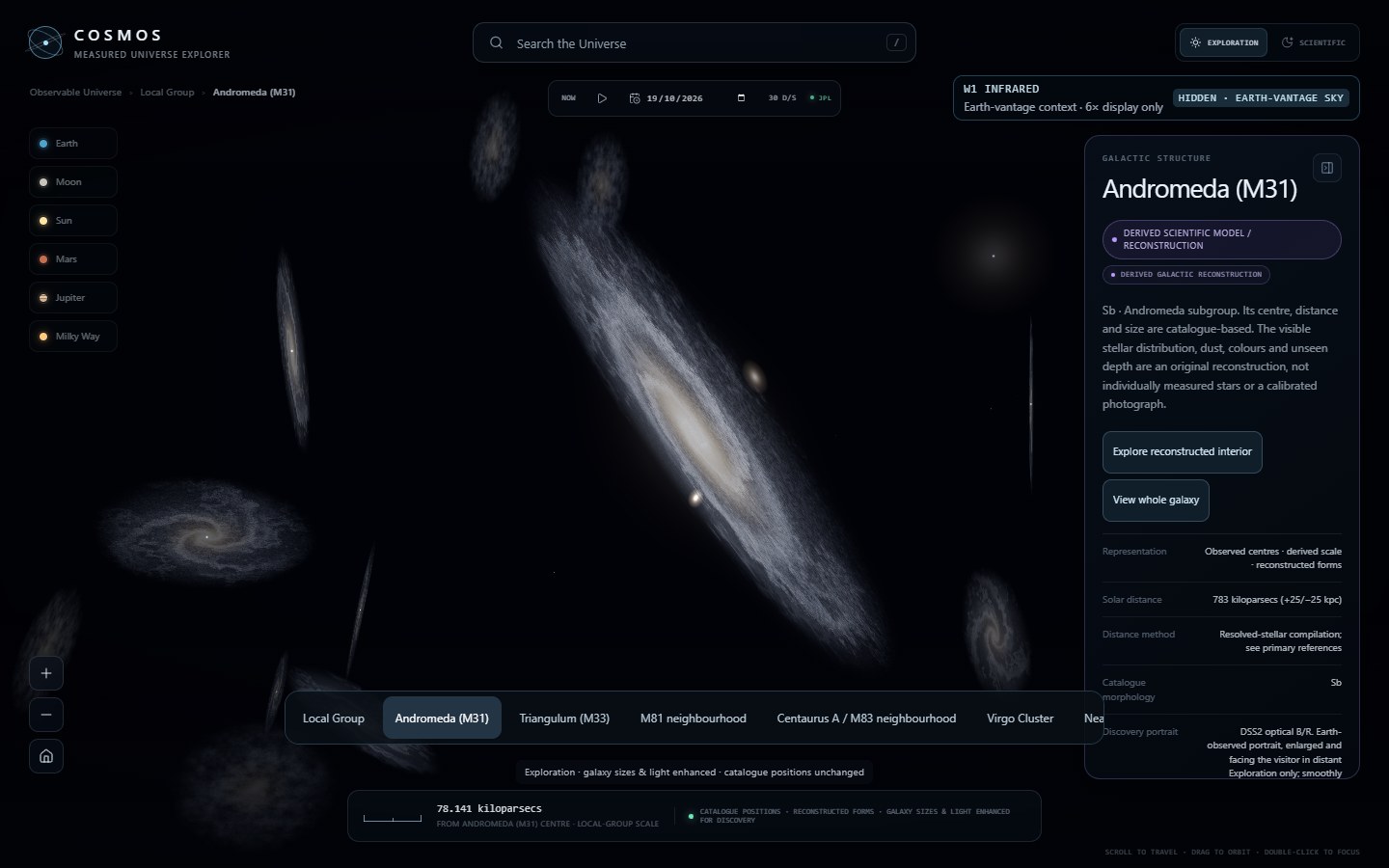
The galaxy centre, distance and orientation are catalogue based. Its attributed DSS2 portrait is an observational image; the surrounding stellar distribution, dust and unseen depth are a reconstruction. Flying through that volume is not equivalent to resolving its individual stars with Gaia.
Use the Beyond the Milky Way journey to compare M31 with the Local Group before approaching it. Switch between Exploration and Scientific modes to distinguish discoverability-enhanced galaxy sizes from physical sizes. The source panel retains the underlying catalogue and display limitations.
Try a scale comparison
First visit the nearby Gaia star field, which reaches 100 parsecs from the Sun. Andromeda is about 7,830 times that radius away. Then return to the Milky Way and move to the Local Group: the gap between separate galaxies becomes easier to understand than it is in a single telescope image.
Sources and further reading
Content updated 2026-10-19. Distance and uncertainty are read from the shipped versioned galaxy record. Light-year conversions are rounded; no observer-location astronomy or live ephemeris is implied.