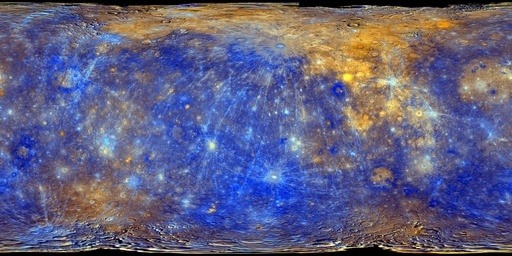
3D planet view · MESSENGER observational composite
Explore Mercury in COSMOS
Global MESSENGER MDIS map shown as an observational composite. Detail stops at the verified NASA Trek matrix ceiling; no terrain is implied. The link below opens the explorer, flying the camera to Mercury with its position set by the archived planetary state.
Measured facts
- Mean radius
- 2,439 kmPublished mean radius stored as renderer geometry.
- Mean diameter
- 4,879 km
- Distance from Earth at the recorded epoch
- 204,712,375 km · 11.38 minutes light time
- Closest camera approach
- 2,679 km from the body centre (240 km above the mean-radius surface)
What opens when you follow this link
COSMOS opens in the same continuous 3D scene and moves the camera to Mercury. Nothing reloads, and the breadcrumb trail stays clickable for the way back outward through the Solar System, the measured stellar catalogue and the Galactic view.
If your browser cannot run WebGL2, this page is still the useful part: it carries the identity, the measured values and the provenance, in text.
Where the full record lives
This page is the share link. The complete data record for Mercury — delivered imagery resolution, observation epoch, source licence, processing chain and every disclosed limitation — is on its reference page, which is linked below.
Datasets behind this page
- JPL Horizons planetary state archive (2020–2040)NASA/JPL Horizons · derived-scientific-model · One discrete geometric state vector per object at JD 2461281.5 TDB
- MESSENGER MDIS enhanced-colour global mosaicNASA/JPL Mercury Trek · USGS Astrogeology · observational-composite · 665 m/pixel delivered NASA Trek color matrix; underlying MESSENGER BDR reference product is 166.31 m/pixel
Content updated 2026-09-26. Every value on this page is computed from the shipped datasets; where a source publishes no value, the page says so instead of estimating one.