guide
What happens to light and time near a black hole?
Gravity changes the paths of light and the readings of clocks. In COSMOS you can approach a black-hole model, orbit the view and compare observers before trying a simulated fall. Ask three questions: why is there a shadow, why does the bright flow appear above and below it, and whose clock are you reading?
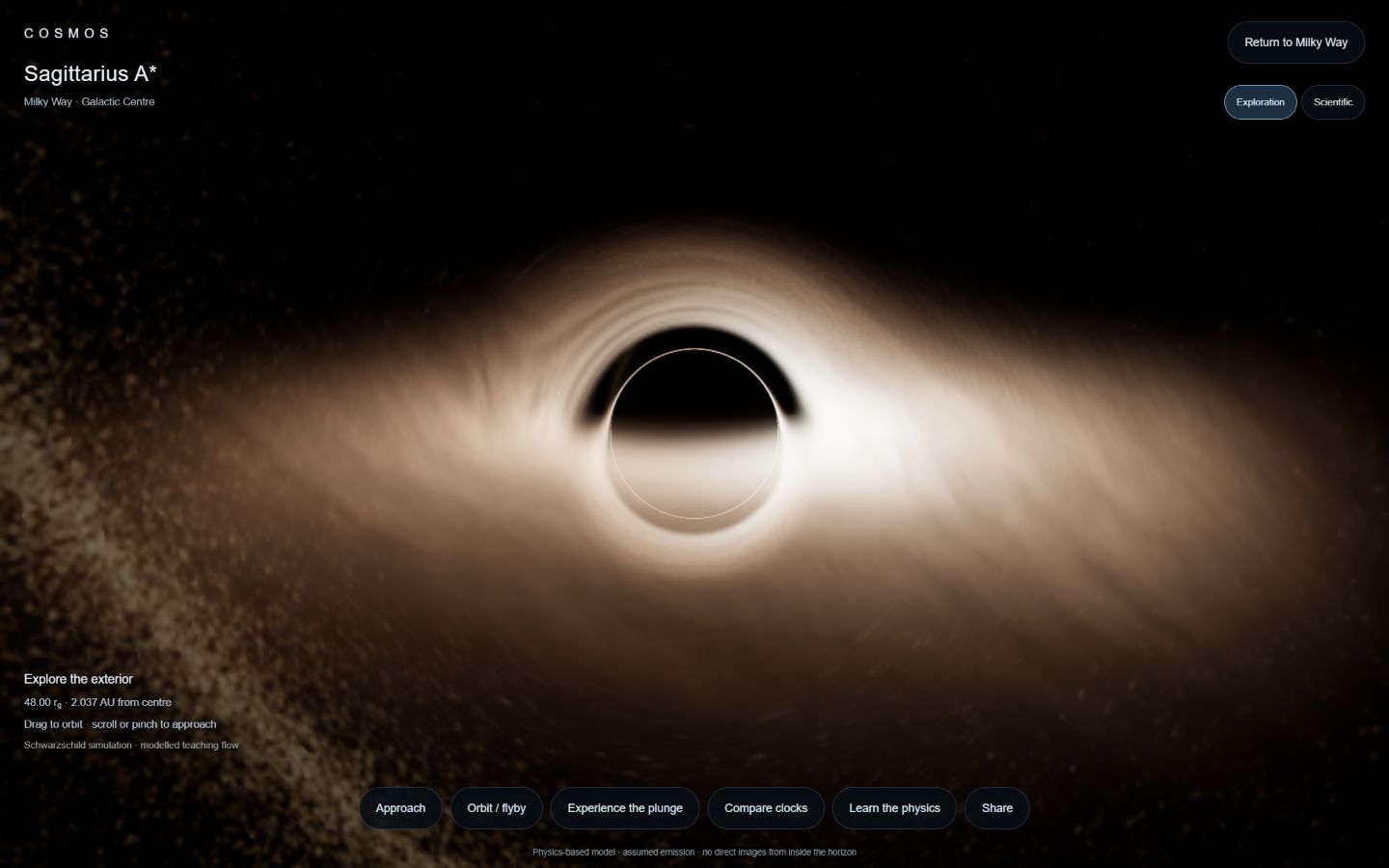
The shadow is not a solid surface
Begin outside and select Approach. Drag to change viewpoint; Orbit / flyby moves the camera. The dark region is the apparent shadow: directions from which the assumed background light cannot reach this camera. It is not a painted ball or a photograph of the event horizon.
Light from the far side of the teaching flow bends around the hole. Some paths place an apparent arc above or below the dark region. Rotate the camera to investigate these images of the same surrounding flow, rather than extra physical rings stacked in space.
Compare clocks: name the observer first
Open Compare clocks. Held and freely falling observers follow different paths through spacetime. Proper time is a reading on an observer’s own clock; distant-observer coordinate time is a different quantity. A held observer requires acceleration and cannot hover at the horizon. The orbiting camera control is not a claim of a free geodesic orbit.
Experience the plunge follows the implemented radial freefall model, with explicitly accelerated playback. It crosses the horizon in horizon-regular coordinates and stops at a stated positive-radius numerical cutoff. That stop is a calculation boundary, not a discovery about the singularity. Restart and Return to Milky Way reset the simulation; they do not demonstrate escape from a horizon.
Measured, modelled or fictional?
Sagittarius A* is the compact object at the centre of our Milky Way. The Event Horizon Telescope published a radio image of its surrounding emission. COSMOS is not that observation: it is an interactive, nonrotating Schwarzschild teaching model. A fitted radio-emission model, black-hole spin and turbulent plasma are outside its scope.
The emitting flow, false colours and exposure are illustrative assumptions. The distant sky reuses the labelled Milky Way reconstruction. Scientific and Exploration modes retain the same light paths while changing presentation. A separately consented Beyond known physics branch is explicitly fictional; neither this model nor observations establish a habitable world inside a black hole.
A five-minute light-path investigation
- Sketch the initial shadow and arcs. Predict what will change when you rotate the camera, then test the prediction.
- Compare clocks outside the horizon. Name the observer and time quantity before quoting a reading.
- Identify one observed fact, one mathematical prediction and one display assumption. Check Learn the physics and the primary sources below.
Sources and further reading
Content updated 2026-10-25. Describes COSMOS controls and its existing numerical model. No new astrometry, ephemeris, scientific dataset or black-hole parameter fit. COSMOS is independent of the cited institutions.